
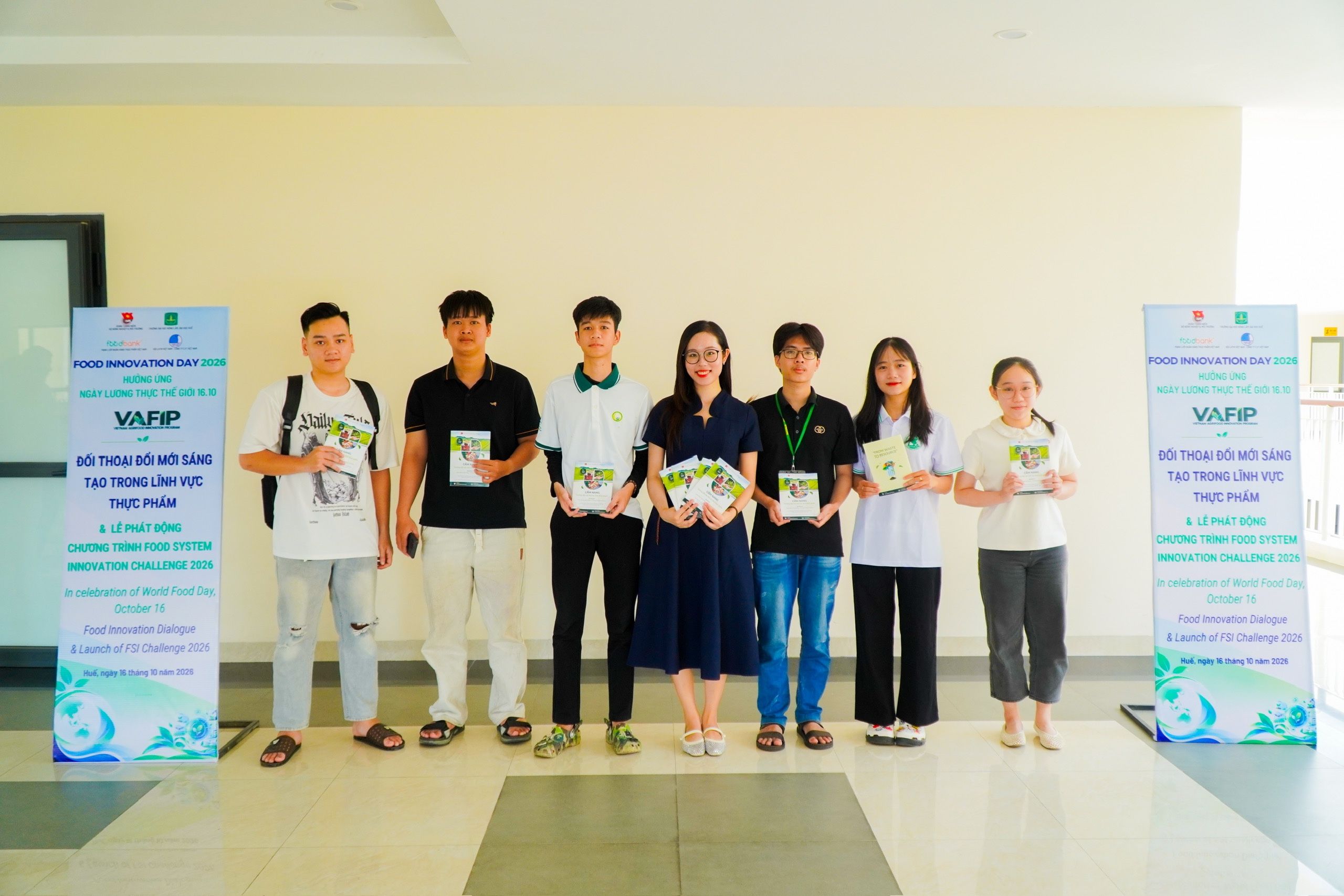
(VAN) Food Innovation Day 2026 aims to promote technology application, reduce food loss and waste, and develop sustainable food systems.

In response to World Food Day (October 16), the Viet Nam Foodbanking Network (Food Bank Viet Nam), in coordination with the Youth Union of the Ministry of Agriculture and Environment, the University of Agriculture and Forestry under Hue University, the Youth Union of C.P. Viet Nam Livestock Joint Stock Company, and partner organizations, organized Food Innovation Day 2026 – Dialogue on Innovation in the Food Sector, the launch of the Food System Innovation Challenge 2026, and the awarding of the Food Hero Scholarship 2026.
The event took place at the University of Agriculture and Forestry under Hue University, with the participation of representatives from agencies, organizations, businesses, experts, scientists, lecturers, and hundreds of students. The program aimed to promote the application of science and technology and digital transformation, reduce food loss and waste, and strengthen resource linkages to develop sustainable food systems.
Innovation: Driving force for developing food systems in the future
Delivering his opening remarks, Mr. Nguyen Tuan Khoi, Chairman of Food Bank Viet Nam, emphasized the role of innovation as the agriculture and food sectors face numerous challenges related to climate change, food security, and food loss and waste.
“After 10 years of establishment and development, Food Bank Viet Nam continues to expand its activities beyond connecting stakeholders to collect and share food toward promoting innovative solutions, technology application, and multi-stakeholder cooperation. Of which, connecting educational institutions, businesses, scientists, and social organizations is considered a key factor in bringing valuable initiatives into practice,” Mr. Khoi said.

From the perspective of mobilizing youth resources, Mr. Ta Hong Son, Secretary of the Youth Union of the Ministry of Agriculture and Environment, shared his views on the theme “Youth and Food Systems Innovation.” He highlighted a strategic shift in the approach of young people in the agriculture and environment sector, transitioning from superficial campaigns toward creating an enabling environment in which young people can directly contribute to solving the sector’s major problem; shifting from physical activism to mastering science and technology, digital data, and innovation; and turning ideas on paper into practical models with commercial potential and scalability.
In particular, Mr. Ta Hong Son emphasized the importance of building an interconnected “4 parties” ecosystem comprising management agencies, research institutes and universities, businesses, and youth.
“A safe, sustainable, and humane food system will not emerge on its own but is built on the awareness, aspirations, and concrete actions of today’s students and young intellectuals. The Youth Union of the Ministry of Agriculture and Environment is committed to being a trusted companion and a strong bridge connecting your innovative ideas with the policies of the Party and State, as well as with resources from businesses,” Mr. Son said.

Within the framework of the program, speakers discussed opportunities, challenges, and solutions for cooperation among educational institutions, businesses, social organizations, and the younger generation. The discussions aimed to strengthen links between research and practical needs, promote technology application, and develop scalable innovation models.
According to Assoc. Prof. Dr. Nguyen Huu Van, Vice Rector of the University of Agriculture and Forestry under Hue University, strengthening cooperation between the university, businesses, and social organizations is expected to create more opportunities for lecturers and students to engage in research, development, and the application of innovative solutions in the agrifood sector.
Promoting youth innovation
One of the highlights of the program was the introduction of the Viet Nam Agri-Food Innovation Programme (VAFIP) and the launch of the Food System Innovation Challenge 2026. VAFIP was introduced as an initiative to connect research resources, technology, businesses, and the startup community, contributing to the development of an innovation ecosystem for the agriculture and food sectors.
Building on this initiative, the Food System Innovation Challenge 2026 was launched to encourage students, research teams, innovators, and startups to propose ideas and solutions to address challenges facing food systems. The initiative aims to create a platform for networking and supporting the development of innovative ideas while promoting cooperation among educational institutions, businesses, and other organizations to translate research-based initiatives into practical applications.

According to Chairman of Food Bank Viet Nam Nguyen Tuan Khoi, the distinctive characteristics and advantages of Central Viet Nam offer young people opportunities to develop models that combine agriculture, food, tourism, digital technology, local culture, and the green economy. What matters is not simply generating new ideas but ensuring that they can address practical problems, be put into practice, and deliver direct value to local residents, businesses, communities, and the environment.
In a message to the event, Mr. Vinod Ahuja, FAO Representative in Viet Nam, welcomed the launch of the Food System Innovation Challenge 2026, describing it as an important platform for young people to turn bold ideas into meaningful action.
“FAO believes that young people are not merely beneficiaries of change but can also help drive that change. As Viet Nam moves toward building more sustainable, resilient, and inclusive agrifood systems, youth should be encouraged to remain curious, think creatively, collaborate across sectors, and turn their ideas into solutions that benefit both people and the planet,” Mr. Vinod Ahuja said.

Mr. Ta Hong Son, Secretary of the Youth Union of the Ministry of Agriculture and Environment, added that the Youth Union, together with its partner organizations, wishes to create a substantive and professional playground built on three strategic pillars of action: Practical Innovation – From lecture halls directly to the fields; A Connected Ecosystem – No one succeeds alone; and Human-Centered Innovation – Social responsibility and humanistic values.
Within the framework of Food Innovation Day 2026, the Organizing Committee announced plans for cooperation between the University of Agriculture and Forestry and FSI Hub. The cooperation will focus on connecting research, supporting idea incubation, and developing innovation activities in the agrifood sector. It aims to leverage the respective strengths of both parties in education, research, resource mobilization, and youth support, thereby laying the groundwork for collaborative programs and innovation development in the coming period.

On this occasion, the Organizing Committee also awarded 30 Food Hero Scholarship 2026 grants, worth a total of VND 45 million, to students facing financial difficulties at the University of Agriculture and Forestry.
Through these activities, Food Innovation Day 2026 contributes to fostering stakeholder engagement in the development of sustainable food systems while encouraging the younger generation to contribute ideas and solutions for the future of Viet Nam’s agrifood sector.
Theo Báo Nông nghiệp